The Peace Academy is a partner in translating and publishing literature dedicated to the fight against right-wing populism, religious and ethno-national radicalization and violent extremism.intended for the academic and activist communities. 

Dear friends of the Peace Academy,

We have come to the time for a new phase here at the Peace Academy. Our plans are to focus in the next period on establishing a study of peacebuilding practice in divided societies building on our experience and work in BiH. Within this framework, we are exploring a summer academy for 2020.

We are also saying goodbye to Slobodanka Dekić, Nebojša Šavija-Valha, Tamara Šmidling, and Emina Trumić who have been dedicated colleagues for many years. The energy of this existing group to move the Peace Academy forward has been reduced by professional, activist, and personal engagements. A new board has been formed which is made up of Nejra Čengić, Amela Puljek-Shank, and Azra Smailkadić-Brkić, all of whom have been closely involved with the Peace Academy’s programs. Together we hope to give the Peace Academy renewed energy and focus but which remains true to the values and mission on which we were established.

We are always happy to hear from those of you who were participants and collaborators in our programs until now. Please let us know if you would like to be involved in this new phase in any way.

Randall Puljek-Shank

Rationale

  • By peacebuilding we mean, “a comprehensive concept that encompasses, generates, and sustains the full array of processes, approaches, and stages needed to transform conflict toward more sustainable, peaceful relationships.” (Lederach 1997: 35) Peacebuilding is concerned as a result both with change in institutions and social change.
  • Despite the advent of the ‘local turn’ within International Relations (Joakim Ojendal, Schierenbeck, & Hughes, 2017; Mac Ginty & Richmond, 2013), peacebuilding as an activity by local actors with agency remains marginal in the literature as a conceptual focus. This initiative aims to contribute to this focus, strengthening this empirical research in a way that bridges disciplinary and institutional boundaries.
  • Although there is a growing interdisciplinary literature on peacebuilding in BIH, it exists in a vacuum, largely separated from peacebuilding practice. Peacebuilding practitioners and practice benefit from critical reflection and engagement with academic rigor both to articulate their understandings of peacebuilding practice and also to ask tough questions about what does or doesn’t work and why.
  • This is additionally relevant because peacebuilding as both a practice and a literature came of age with the case of BiH (Boutros-Ghali’s UN Agenda for Peace) – this is a critical reflection upon more than 20 years since this advent of peacebuilding as such.


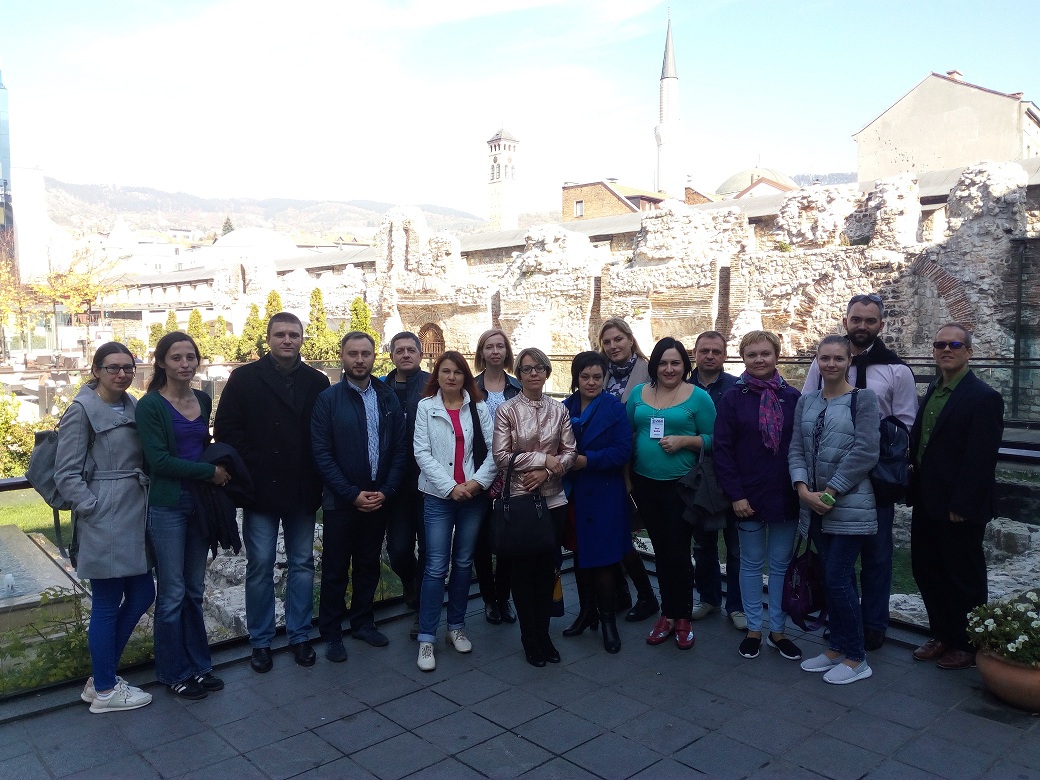
A group of ten government officials and nongovernment employees from across the Ukraine visited Sarajevo from October 15-22, 2017, in the context of a study trip on the topic of the “Role of government, civil society, and private sector in helping internally displaced persons (IDPs) to gain employment”. The goal of the visit was to share Bosnia and Herzegovina’s experience in providing assistance and protecting rights of IDPs after the Dayton Peace Agreement from the viewpoint of BiH’s institutions, nongovernment and international organizations, and private companies. The training and study trip was organized by the Peace Academy Foundation based in Sarajevo with the support of USAID and World Learning.